Judgement in ExxonMobil Canada Case
On 6 March 2026, the Tax Court of Canada made its judgement in the Case “ExxonMobil Canada Resources Company v. The King” (published online here). It relates to a reassessment of the taxable income for the business year 2001 made by the Canadian tax authority in 2009.
ExxonMobil Canada Resources Company (“EM Canada”) had appealed this reassessment in 2017, and the case had been heard by the tax court in 2025. Main aspect of the judgement is the treatment of allocated costs for the feasibility study of a pipeline project.
With this judgement, the tax court clarifies important aspects of the application of Canadian tax law. Furthermore, it outlines general principles for the conduct of transfer pricing analyses and their reporting. The latter aspects will be analyzed and discussed in the following.
Outline of the Facts
The feasibility study related to a considered natural gas pipeline project from Northern Alaska via Western Canada into the contiguous United States. It was conducted in 2001 by ExxonMobile Production Company (“EM Production”) with BP and Phillips, two unrelated multinational groups. The project considered would have been a joint venture between these three groups.
As a general policy, ExxonMobil manages any pipeline and part of a pipeline in a specific country via a local affiliate. For this reason, EM Production allocated a part of its share in the pipeline project to EM Canada via an intercomany agreement (“ICA”). This resulted in EM Canada also being responsible for a proportion of the costs for the feasibility study.
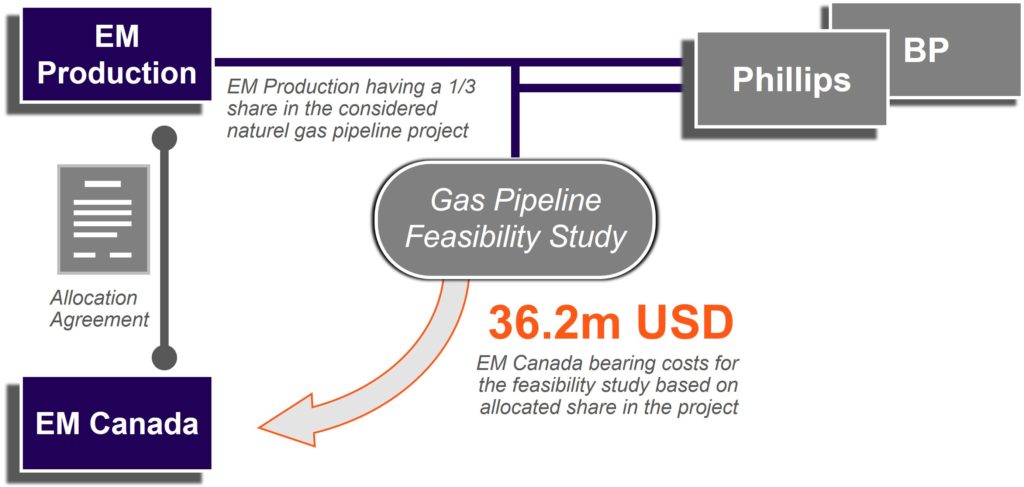
The results of the feasibility study became available in early 2002. They showed the project not being economically viable and resulted in its cancellation. EM Canada’s share in the study costs amounted to about 36.2 million US dollars (“USD”). The costs were expensed and deducted from the taxable profit for 2001. The allocation relied on the proportion of the length of pipeline that would have run through Canada and therefore would have been operated by EM Canada.
The Canadian tax authority challenged this as non-deductible from taxable profit. This mainly rested on the argument that independent parties would not have engaged in such a transaction. Rather, the tax administration recharacterized the ICA as a service agreement for a fee. Under arm’s-length conditions, EM Canada would therefore not have borne any costs for the feasibility study.
Court Considerations
Before the actual analysis of the case, the tax court reviewed and confirmed the principles applied in previous transfer pricing cases. This included especially the rule that transfer pricing must be aligned with the functional profile and the commercial interests of the related parties. For the latter, independence has to be assumed. Furthermore, the case law confirmed the use of a range of reasonable results instead of a point estimate. Finally, the court reconfirmed that for Canadian tax purposes, the OECD Guidelines are not controlling. Nevertheless, they were an important part of the following analyses, thereby underlining their practical importance even in jurisdictions, where they have not the force of statutory law.
Core question of the recharacterization argued for by the tax authority was if EM Canada could reasonably expect an appropriate financial return. The court affirmed this, based on the statements of different witnesses and other evidence provided. Specifically, at the time of the ICA, EM Canada could reasonably expect annual equity returns from the pipeline of more than 160 million USD. Over the lifetime of the pipeline this could have amounted to about 6.5 billion USD, thus justifying the allocated feasibility study costs.
Regarding the contents of transfer pricing analyses, the tax court stressed that (1) industrial analyses, (2) company analyses, and (3) functional analyses are needed. These were missing in the submissions from one of the expert witnesses, severely undermining his credibility in the eyes of the court. Furthermore, the actual economic analysis requires (4) selection of a transfer pricing method, (5) a comparable transaction, and (6) consideration of adjustments. A widespread understanding of the transactions and the related party’s circumstances is integral to accurately delineate the relevant facts. This includes a comprehensive economic appreciation of the underlying legal contract.
These considerations lead the Tax Court to rejecting the application of the transfer pricing provisions of the Canadian tax law. Here, “transfer pricing provisions” refers to a recharacterization or adjustment of terms of the controlled transaction. The question, if it is a controlled transaction in the first place was not an issue. With the judgement, the tax authorities were instructed to reassess EM Canada’s tax year 2001 accordingly.
Conclusions
The pondering between adjustments of terms and conditions on one hand and recharacterization of a controlled transaction is typical for legalistic thinking. It stems from legal systems providing distinct archetypes of commercial contracts and is fundamentally alien to the more fluid approach of economics. While courts show a strong general tendency to follow economic reasoning, tax authorities still often hold on to such concepts. Instead of rejecting those in court, it is advisable to address them proactively in transfer pricing analysis and documentation.
Main insight of the judgement is the expectations of the tax court regarding the contents of these analyses. Here, the court showed a high degree of consistency with the requirements of the OECD Guidelines as well as internationally recognized valuation standards. Accordingly, it provides no new elements. Rather, they can be understood as a by-the-book implementation of a transfer pricing analysis.
For the volume of the controlled transaction addressed here, this is clearly appropriate. For many “regular” controlled transactions however, compromises will need to be made to some degree, as extensive effort is often not justified by their size. Here, taxpayers should make informed decisions after consulting with experts in the field.
As a specialized valuation firm, we are ideally situated to advise our clients – as well as prospective clients – on such matters. For example, we have extensive analysis in performing standard-compliant transfer pricing analyses for our clients. Feel free to reach out with question about economic analyses and related transfer pricing or valuation topics to our team under info@bdanalysis.ch.